


The Changing Role of Women in the USSR: Production and Reproduction
“A Soviet woman is equal in rights with a man ... But our Soviet woman is not exempt from that great and honourable duty that nature has endowed her with: she is a mother; she must give birth.” Conscience of the Party, Aaron Soltz (1937)
The Communist Party’s Family Codes of 1918 and 1926, alongside a series of laws between 1917 and 1920, presented a radical and progressive shift for women – emancipating them. These changes included the legalisation of a ‘no-fault divorce’ (where neither partner must prove wrongdoing of the other); legalised abortions; brought an end to the concept of ‘illegitimate children’ and ended church involvement in marriage, with the ability to perform marriages handed wholly to the state. The laws also set a minimum age of marriage: sixteen for women and eighteen for men. Greater equality was further established with the end of bride prices and polygyny (the marriage of a man to several women). In 1920, the USSR became the first country in the world to provide abortions for free in state-run hospitals. Most significantly, the Soviet constitution also proclaimed the full equality of men and women, with the right to vote, alongside the banning of discrimination on gender. From 1926, Soviet women were able to own property separately from their husband. Progression only continued - article 122 of the 1936 Constitution reinforced the legal equality between men and women.
This commitment to women's emancipation was highlighted by the establishment of the Zhenotdel in 1918, by Alexandra Kollontai and Inessa Armand. The Zhenotdel were the women’s department of the Communist Party and had a significant role in the progression of women’s equality, as it provided change for women, by women. They limited the marginalisation of women within trade unions and encouraged female political activism on a local level, as well as organising the opening of communal canteens, laundries and children’s nurseries to ease the female domestic burden. Female recruitment schemes were established, alongside workplace inspections to protect workers health and safety. The Zhenotdel also achieved the legal inclusion of paid maternity leave (before and after birth) alongside access to nursing rooms at work.
Educational reform also provided greater equality for women - by 1930, 28% of university students were female, compared to just 12% in Germany - in 1935, this rose to 38%. In 1940, 40% of engineering undergraduates were female, and in the 1960s, 50% of graduates were women.
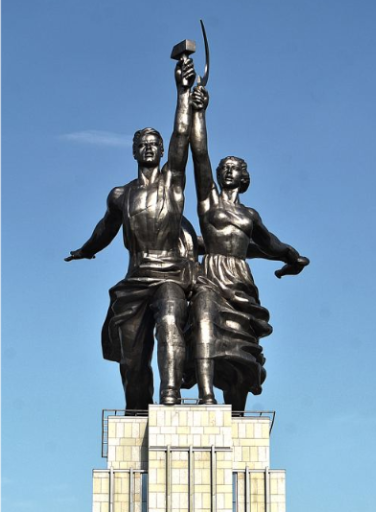
Vera Mukhina’s statue Worker and Kolkhoz Woman (1937) represented the gender equality of the USSR, as both man and woman stood united under Communism. However, this statue also demonstrated a persisting gender hierarchy: the man’s power and leadership highlighted by his hammer compared with the woman’s sickle beneath the hammer, highlighting her supportive, secondary role. The statue highlights the division between theoretical equality in the USSR and the actual hierarchical gender difference.
The legal promise of equality and liberation for women led to genuine progression in women’s daily-life, with the easing of domestic burdens and increasing availability of abortion and political representation. However, this progression was limited and would ultimately revert.
Despite the promise of emancipation within the USSR, under the 1921 New Economic Policy (NEP) women's equality significantly declined. The NEP was a short term retreat from communism to revive the economy after the strain of civil war. Under the NEP, funding for communal canteens, nurseries and laundries was cut, once more placing the domestic burden on women’s shoulders.
The return of men from the civil war led to a rise in female unemployment, as they were illegally discriminated against within the workplace. This pushed many women into prostitution and sex-work as demand amongst men increased. In 1922, prostitution was officially decriminalised, and due to the mass unemployment, desperation and a wealthy new class of client (the“NEPman”) the number of men using prostitutes rose to 39% of the male population. Alexandra Kollontai (a pioneer of women’s rights) depicted the ‘NEPwoman’ as sexually dangerous,‘tarted up like a streetwalker…[with] furs draped over one shoulder and rings sparkling on her fingers’. This shifting perspective of women - and their mass unemployment - greatly reduced their previous freedom.
The criminalisation of abortion in 1936, alongside the increasing inaccessibility of birth control, reversed the control that women had gained previously. This policy pushed many women towards illegal, backstreet abortions, with female deaths from these procedures rising to c.4,000 each year in 1949-55. Stalin complicated the process of divorce, making it more expensive and difficult, reducing the liberation women had previously found.
The abolition of the Zhenotdel in 1930 further reduced women’s equality, as their political representation and advocates disappeared. This inequality was evident within the Communist Party itself: female deputies had accounted for 49% of deputies in smaller, local roles; this declined to just 32% in the Supreme Soviet (the legislative body of the party). Likewise, 33% of the primary organisation secretaries were female, compared to just 4% at city and district level. Female voices were noticeably absent from the party elite and were reflective of a wider problem within the USSR. Although 45% of industrial jobs were held by women in the 1960s, just 1% of factory foremen were female, highlighting the limited opportunities for promotion and leadership. Lack of career advancement was compounded by wage inequality, with women earning around 60% less than their male counterparts for the same work.
The woman’s ‘double burden’ of reproduction and production was the most significant element of a woman’s role in the USSR, and a prime example of the Orwellian concept of the Soviet ‘doublethink’ - the acceptance of contrary beliefs at the same time due to indoctrination.
Reproduction: Under Stalin, the role of women “as a mother and a citizen” expanded, with propaganda glorifying motherhood as the backbone of the future of the Soviet state. This was demonstrated with the creation of the ‘Mother Heroine’ awards, for mothers of ten or more children and the ‘Order of Maternal Glory’, for mothers of seven or more children, highlighting Stalin’s commitment to increasing the birth rate and the maintenance of the family unit. Without communal canteens, childcare, or laundries, an increasing domestic burden was placed on women, without expectation for fathers to ease the load. Male alcoholism and absent fathers were commonplace, as highlighted by satirical magazines, such as Perets, Vozhyk and Krocodil (as shown on the right), showing how childrearing duties rested solely on women.

Production: Whilst the “joy of motherhood” and the importance of women as mothers only increased under Stalin, the importance of female productive and economic contribution also increased. Valentina Tereshkova’s space mission and Dusya Vinogradova’s records of manufacturing achievements highlighted the importance of women as economic contributors. The number of women in work increased from 3 million in 1928, to 13 million in 1940. Under the Soviet ‘doublethink’ women were expected to work, just as any man would, whilst also having children and carrying the domestic burden. The difficulty of women’s eight hour work shifts, alongside four to six hours of unpaid domestic work became their “double burden”. This unequal expectation highlighted the limited freedom of women in the USSR, as gender divisions were once more reinforced within the family.
Bibliography
https://www.graduateinstitute.ch/communications/news/lifting-iron-curtain-gender-policies-soviet-union - Lifting the Iron Curtain of Gender Policies in the Soviet Union
kistan - Women at the Heart of the Revolution
nd-post-revolutionary-russia/ - ‘Dangerous Women’ – Prostitution in Late Imperial and
Post-Revolutionary Russia.
skiy-satyri - A Worker, A Victim, A Consumer: Images of Women in Soviet Satire
https://blogs.manchester.ac.uk/hcri/2021/03/31/womens-history-month-2021-women-after-the-bolshevik-revolution-equality-and-independence-a-brief-introduction-to-the-role-of-women-in-the-early-soviet-union/ - Women’s History Month 2021: Women after the Bolshevik Revolution:Equality and Independence? A brief introduction to the role of Women in the early Soviet Union.
https://archives.history.ac.uk/history-in-focus/Gender/chatterjee.html - Women at the Gates:
Gender and Industry in Stalin's Russia
Niparishvili T., 2023, The Status of Women in the Soviet Union, Journal of
Geography, Politics and Society, 13(1), 1–10
=AfmBOopl9VhvdZ4rAnIRWyh0_4zxt0B1zogZmr4Btybx-n9jorukGrIi - From Suffrage to Space:
The Role of Soviet Women
https://communistusa.org/women-in-the-soviet-union/ - Women in the Soviet Union
https://blogs.bu.edu/guidedhistory/moderneurope/molly-wolanski/ - The Role of Women in
Soviet Russia
20in%20Urban%20Russia%2C%201900-1917.pdf - Female Prostitution in Urban Russia,
1900-1917


Comments